


JOHANNES BRAHMS | Four Ballades, Opus 10 (originally for piano solo), published 1854 | instrumentation for horn, double bass and piano
FILE FORMAT: PDF | 600 dpi (48 pages)
RELEASE: final
INCLUDED PARTS: Piano (score), horn, double bass
DOUBLE BASS TUNING: GDAE (standard "orchestra" tuning)
SOURCE: N. Simrock, revised edition, 1888
Johannes Brahms’s earliest published compositions have fascinated me for many years. The level of artistic maturity he had already achieved at the age of just twenty is truly astonishing. Several works from this period seemed particularly well suited to adaptation for the double bass, and the Four Ballades, Op. 10, were among the most significant compositions that remained on my mind over the years.
I produced a number of drafts and sketches for a version for double bass and piano, yet I was never entirely convinced that the idea would work in a truly satisfying way. In the meantime, I completed several larger projects involving Brahms’s music. Through this work, I became increasingly aware of how frequently his writing is shaped by characteristic horn intervals and motifs - sometimes even entire melodies that seem inherently idiomatic to the horn.
When I eventually returned to the Four Ballades, Op. 10, I experienced something of a breakthrough. Throughout the entire cycle, I recognized the same intervallic language associated with the natural horn. At that moment, I realized what had been missing from my original concept all along: the most important instrument of all - the horn.
This insight led to the idea of a new instrumentation: a kind of “Horn Trio No. 2” by Brahms, created entirely from music Brahms himself had written, with only the minimum intervention necessary to make it sound natural and idiomatic for the instruments involved. In a sense, it brings together two instruments that were especially close to the Brahms family. Johannes Brahms grew up hearing both the horn and the double bass, as his father, Johann Jacob Brahms, was a professional musician who played both instruments.
The key scheme of D minor/D major and B minor/B major is omnipresent throughout the cycle and played a decisive role in shaping its structure. It indicates that complete performance was intended by the composer. Readers interested in this fascinating aspect will find a wealth of information and analytical material available online.
After several years of allowing the idea to mature, I finally began working intensively on the arrangement. Following a series of test rehearsals - always with outstanding musicians - the score underwent three complete revisions within the span of six months. Each revision brought substantial changes, refinements, and improvements, until the work finally reached the form presented here today.
I am especially delighted that pianist Maria Sofianska and I were able to record all four Ballades together with the extraordinary Radovan Vlatković, one of the world's leading horn players. The video production of the complete cycle has been published on my YouTube channel on 1 June, 2026, the day that marked 220 years since Johann Jacob Brahms was born.
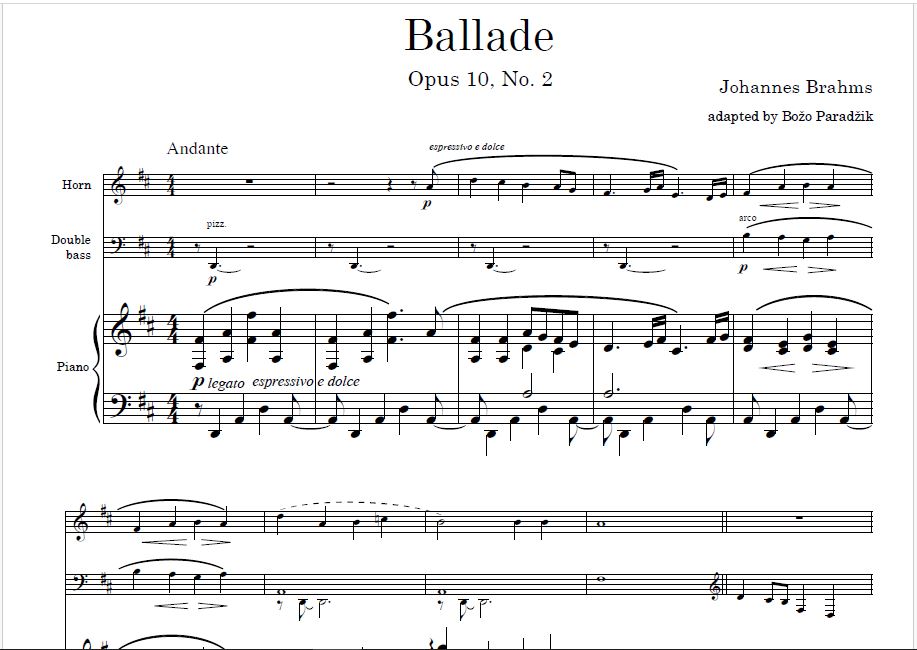
The PDF edition is now available both as the complete cycle and as separate editions of the individual Ballades. Example (screenshot):
ATTENTION: please make sure to click at your desired version of PDF music:
Full version, all four Ballades Op. 10:
*22 EUR | Buy now:

Single ballades:
"Scottish" Ballade Op. 10, No. 1 in D minor:
*8 EUR | Buy now:
Ballade Op. 10, No. 2 in D major:
*8 EUR | Buy now:
Intermezzo Op. 10, No. 3 in B minor:
*8 EUR | Buy now:
Ballade Op. 10, No. 4 in B major:
*8 EUR | Buy now:
*only for the EU- and UK-residents: the customers will be additionally charged with a VAT on e-services during the checkout process. After your confirmation of the country of your residence, your respective country will automatically add VAT in its common VAT-rate. The electronic items like scores in PDF format are also affected by this rule, which is applied since 2015.