


W. A. MOZART | Sonata in E minor (originally for violin and piano) | instrumentation for double bass and piano
FILE FORMAT: PDF | 600 dpi (28 pages)
RELEASE: final
INCLUDED PARTS: Piano (score), 3x double bass
TUNING OF DOUBLE BASS: GDAE, AEBE and cGDAE
SOURCE: Urtext editions, based on composer's autograph
COMMENT:
Mozart’s famous E minor Sonata, performed on the low-tuned double bass (GDAE, “orchestral tuning”), is now available.
I used to envy pianists and violinists their opportunities to perform Mozart’s chamber music. Mozart never wrote anything comparable for the cello—let alone for the double bass. At first, I thought it would hardly be worth experimenting in this direction, as I simply could not imagine any of Mozart’s great works sounding “right” on the double bass. And yet, this version feels convincing to me.
The voices from Mozart’s original score have been transposed and distributed with great precision, though in somewhat unconventional ways. The double bass occasionally takes over the lowest line, which in the original is played by the pianist’s left hand. The idea was to integrate the instrument’s natural low register into the overall sound of the work as much as possible, without losing any of Mozart’s character.
There is no need to comment on Mozart’s musical style—his music practically defines the early Classical period. I can even imagine hearing this sonata at orchestral auditions in place of the Dittersdorf or Vanhal concertos, which, incidentally, are themselves not original compositions for the modern double bass. The Mozart sits lower in the register and demands a wider range of articulation, bowing technique, and refined musicianship from the performer.
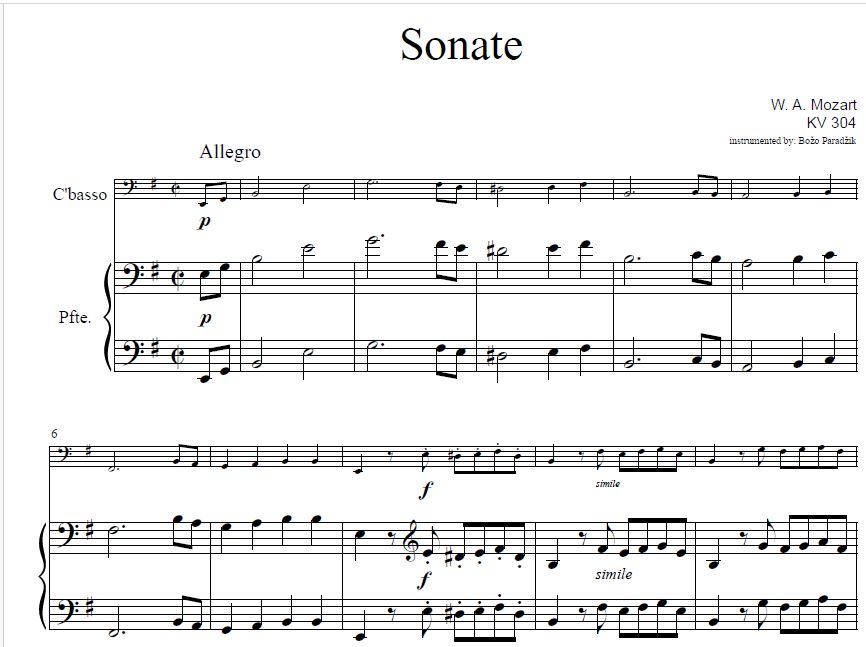
Watch the first movement on YouTube to hear how this instrumentation sounds in practice:
*15 EUR | Buy now:

*only for the EU- and UK-residents: the customers will be additionally charged with a VAT on e-services during the checkout process. After your confirmation of the country of your residence, your respective country will automatically add VAT in its common VAT-rate. The electronic items like scores in PDF format are also affected by this rule, which is applied since 2015.